
Image courtesy of the World Poker Tour
One of the most frequent questions I get from players wanting to improve is: how do I know when to continuation bet, and how much should I bet when I do?
The best way to figure this out is to ask yourself these three questions:
- Does your opponent have any obvious flaws in their strategy?
- Do you have a range advantage?
- Where does your hand fall in the four hand categories?
In this article, we’ll focus on situations where you are the preflop raiser and playing in position, but these principles apply across the board, albeit with some range adjustments.
#1 Does Your Opponent Have Obvious Flaws?
First of all, if your opponent makes obvious mistakes, you should be taking advantage of those mistakes.
One of the biggest flaws players tend to have is that they’ll call very wide before the flop and then proceed to fold a lot on the flop. If you know this to be the case, you should c-bet almost every time. This approach has served me well over the years, even in higher-stakes games.
On a random board, your opponent will make a pair or a draw, i.e., a hand that they’ll want to continue with, about 40% of the time. When determining how often they’ll fold, you simply take 100% and subtract the percentage that they’ll continue.
So, in this example, it’s 100% – 40% = 60%.
To figure out how often a complete bluff with pretty much no equity needs to succeed, you take your bet and divide it by the pot size and your bet (bet/(pot+bet)).
So, if the pot is $100 and we bet $100, if we pick up this pot more than half the time, then our bluffs will be automatically profitable.
If you bet even smaller, like one-third pot, you need your opponent to fold more than 23% of the time for your bluffs to be profitable, and you’ll find that most players simply don’t defend enough, even against small bets.
Of course, there are other flaws you’ll notice in certain opponents.
Some of them almost never fold, and against these types of players, you’ll want to bet wider for value, even with hands like bottom pairs and some ace highs. Some are too aggressive and will always attack weakness; against them, you can check on the flop with your strong hands and snap off their bluffs on the turn.
#2 Do You Have a Range Advantage?
If your opponents don’t have any obvious flaws that you can take advantage of, you need to come up with a GTO strategy on the fly. To do this, the most important question to ask is: do I have a range advantage?
You can figure this out by using a program like Equilab that allows you to run your entire range against the opponent’s range and see how the two compare.
In general, when you have a significant range advantage, you want to bet small and frequently. When our range advantage is smaller, we should bet less often but use a larger sizing.
For example, we raise from an early position and the flop comes A-Q-3. Here, we have a significant range advantage of 64%.
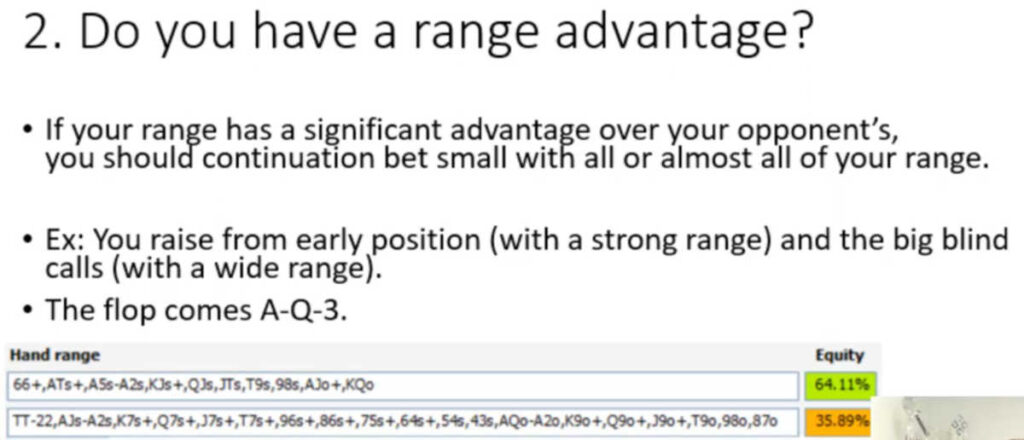
If we take the same scenario, but the flop comes 8♥7♦6♣, our equity drops to 53%, which means that our c-bet frequency should go down, and when we do bet, we’ll be betting three-quarters or full pot.
In general, as the board becomes more draw-heavy, you typically want to bet larger to extract value from draws, and you don’t care if this folds out some of their weakest draws like gutshots.
#3 Where Does Your Hand Fall in the Four Hand Categories?
Once the flop comes, your hand will qualify for one of the four hand categories:
- Premium made hand – top pair with a strong kicker or better – which you can usually bet on all three streets.
- Draws – from straight and flush draws to gutshots to even overcards in some instances.
- Marginal made hands – top pairs down to some ace highs – bet once or twice.
- Junk – like 8c7c on A-Q-4 with no clubs, so you have nothing.
We are betting with our premium made hands and draws and checking with marginal hands and junk. By doing this, we are not making it easy for the opponents to figure out if our hand is strong or weak.
This is very important, as it makes it difficult for the opponents to make good decisions against us. In poker, you make money when they make mistakes, and if they can’t figure out what you have, they’ll make mistakes.
Let’s now go through these different categories using an example hand. We raise from a middle position, and the flop comes 9♥7♥3♣. We don’t have a range advantage here, which is usually the case when we are the preflop raiser and the board contains middling cards. So, we certainly don’t want to c-bet 100% against good players.
With that in mind, how do different hands in our range fit the strategy? In the picture below, we have made hands in red that we want to bet with and hands in blue (our draws) that we’ll be betting as well. Hands marked in green are our marginal made hands, and the grey ones are junk, and both of these categories we are checking behind.
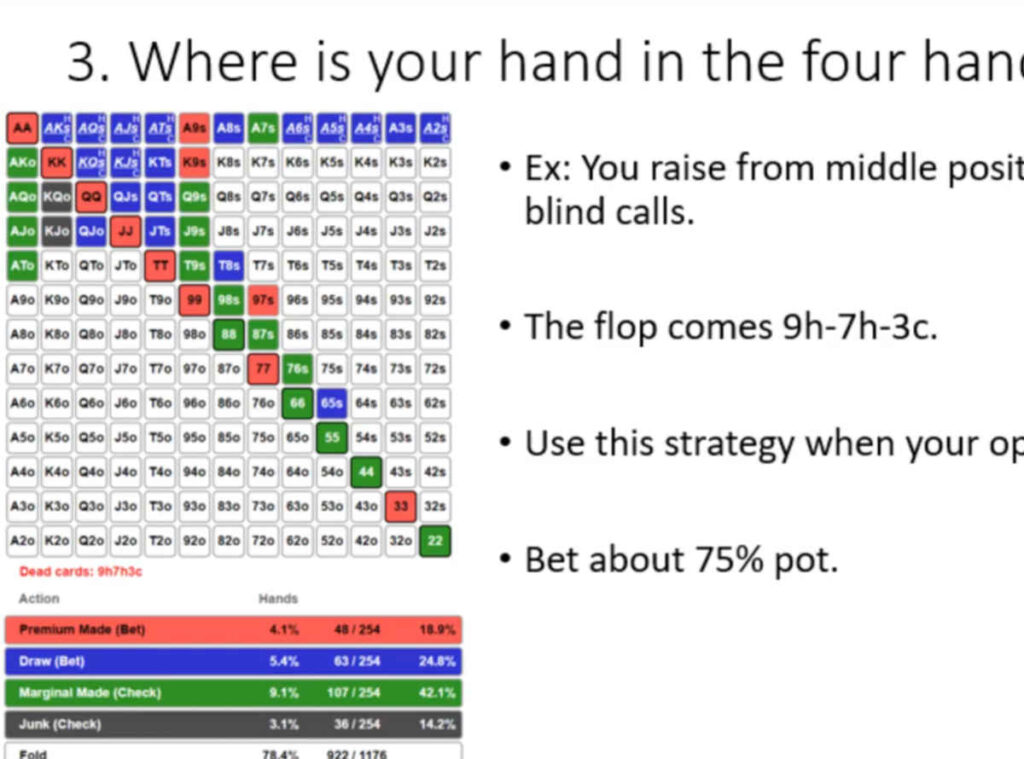
In the made hand category, we have overpairs, sets, one two-pair combo, and then A9 and K9. These are all good hands that make sense to bet with.
When it comes to draws, we have hearts and clubs (backdoors) for flush draws, and then we also have a variety of straight draws and some overcards, like AQs, KQs, and QJs. By playing this way, you make it difficult for your opponent when an overcard comes on the turn, like a random king or a queen.
We also bet with A8 because that hand will make a lot of straight draws on different turns, plus a random ace will be good a lot of the time.
In general you want to have 2:1 and 1:1 ratio bluffs to draws, depending on how deep stacked you are and here we have about that ratio. I like to have as many bluffs as possible, but this strategy works better against weaker opponents. Against good players, you want to have a solid balance, like the one we are working with.
Marginal made hands are some of your top pairs down to 98, pocket pairs from 8s down to 2s, and A7 for a middle pair. Then, we have AK, AQ, AJ, and AT without a flush draw. These hands can check back on the flop and then call a turn bet to see what develops on the river.
You want to make sure you have some top and middle pairs in your check-back range; otherwise, your range is not strong enough, and your opponents can bet on almost all turns and easily win the pot. By having these hands, you are protecting your range.
Our junk hands are KQo and KJo. These hands will still improve sometimes, and if they don’t, you can simply fold when your opponent bets on the turn.
Of course, it is important to tinker a bit with your range to make sure you don’t have too much junk and not enough bluffs. This is why working away from the tables and analyzing your hands is crucial for your long-term success.
The more you do it, the less you’ll wonder if online poker is rigged, as you’ll realize that good strategy and quality play will make you a winning player!