
Image courtesy of the World Poker Tour
One of the questions I get often is: how do I get good enough and start crushing at poker if I don’t have the bankroll for the stakes I want to play?
The truth is, you don’t need that much money to get started. I began my poker journey with just $50 years ago. There are many freeroll tournaments and cheap MTTs with added money that you should pursue to build your poker bankroll.
But these days, you also have another option to prepare for tougher games without actually having the bankroll to play in them, and that’s through studying the game with solvers like PeakGTO.
Solvers and trainers allow you to play as many hands as you like and get a ton of experience that’s almost identical to playing online, but you don’t have to risk any money. You can’t use real-time assistance while playing, but you are free to practice with solvers for as much as you want.
Focus on Common Scenarios
The best way to make the most out of your time spent studying is to focus on common and frequently recurring situations. These are the kind of spots you’ll find yourself over and over again, which means your decisions will have a big impact on your bottom line.
One of the many such spots is playing on the button in poker tournaments, with 40 big blinds effective.
When you are first starting and building your poker bankroll, you should build solid foundations. Learn the proper GTO strategy and assume you don’t know anything about your opponents’ tendencies. As you get better and make progress, you’ll be able to throw in some adjustments.
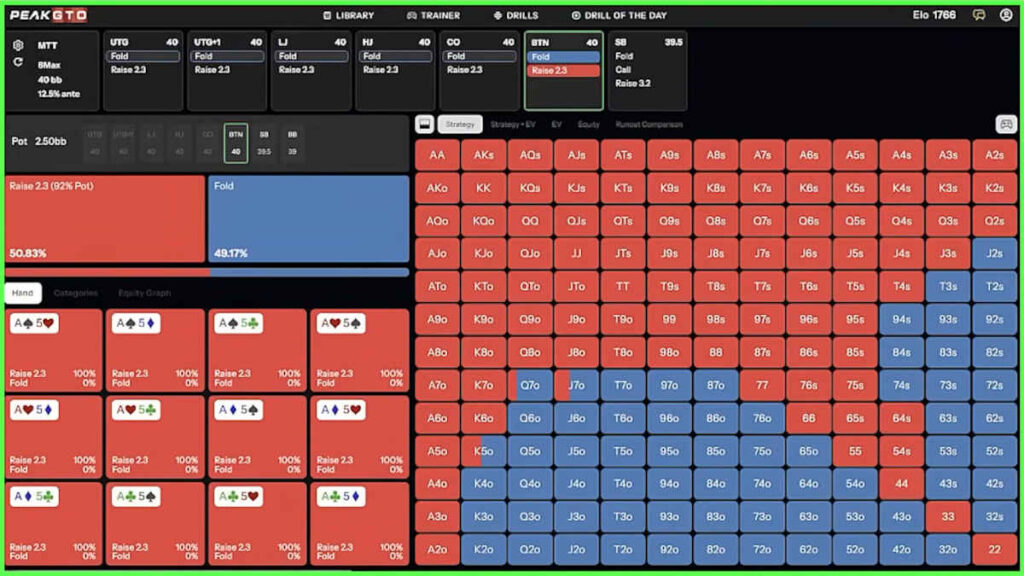
In this particular spot, we are supposed to raise with about 50% of our range on the button, making it 2.3 big blinds (or as close as possible to that amount). If we are playing 200/400, we make it 500, if there are no smaller denomination chips in play.
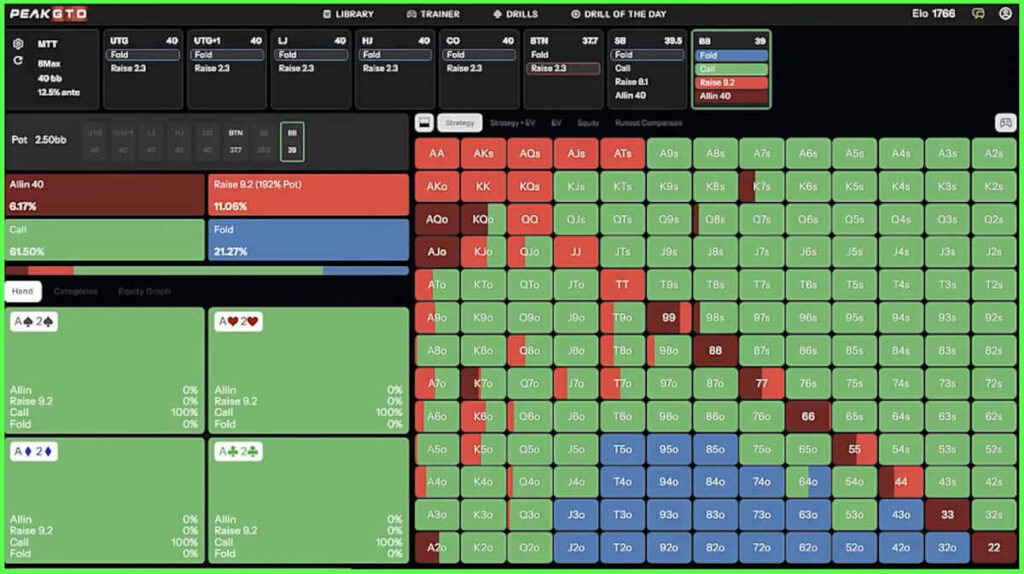
Your opponent should respond as shown on the graph below. They should be re-raising with the hands marked in red, which includes some very strong holdings and some bluffs. At the small stakes, though, most players don’t raise nearly enough with the bluffing portion of their range.
After they call and check on the flop, we need to decide how to proceed, and this is where the PeakGTO Trainer comes in.
Practice Makes Perfect
With the PeakGTO Trainer, you can set up this particular scenario: 40 big blinds effective, raise first in, and we can even set up the board type we want to practice (if you want to practice paired or monotonous boards, for example).
Once you start, you’ll get dealt hands and will get to play through them, make your choices, and then see how your choices measure up against the GTO strategy.
For example, we are dealt 5♥4♥ and after we raise and the big blind calls, the flop comes K♦7♣6♥. Once the opponent checks, we need to decide how to proceed: check back, bet small, or bet big.
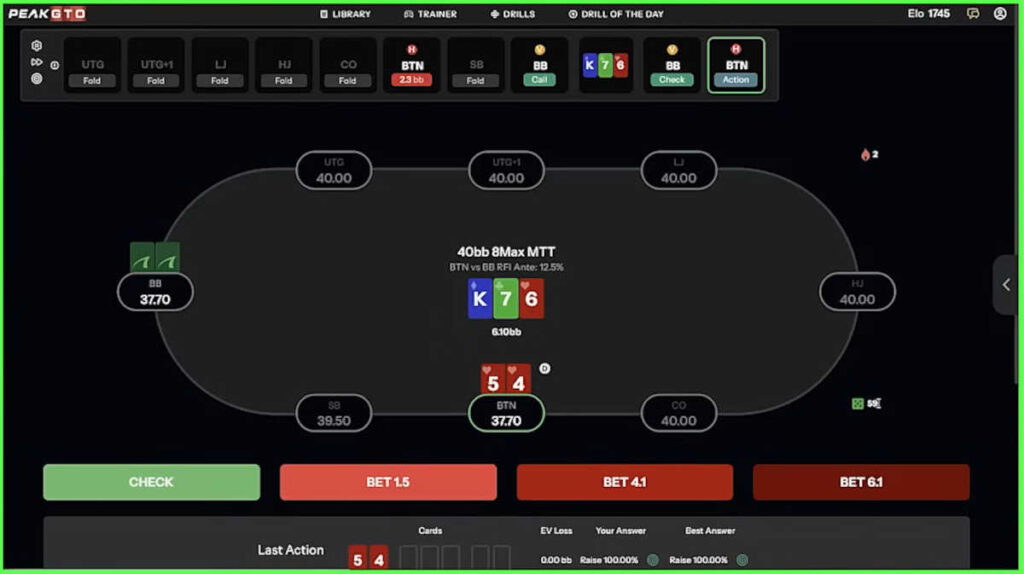
In this particular instance, I go for a small bet; they call, and the turn brings the Q♦. Checking back is certainly an option, but this hand feels low enough where we might want to go for a big bet to try and win it right here. So, I opt for a pot-sized bet, and they fold.
Once you play through the hand, you can find it in the list and click on the “Study in Library” feature. It will pull up the situation and show us how we are supposed to play this hand on every betting round.
What we see is that our hand mostly wants to check on the turn, with only 5♦4♦ doing a bit more betting due to having more equity.
This only goes to show you that poker, and especially GTO poker, is hard, and you’ll need to spend a lot of time studying and analyzing situations to become really good at it.
You can check out the embedded video to see more hand examples and the PeakGTO Trainer in action, but the bottom line is this: if you don’t have the bankroll and want to become good at poker, this is the way to go. You can play as much as you want, learn what the correct strategy is in any given spot, and making mistakes won’t cost you a single cent!


