Image courtesy of the World Poker Tour
In today’s article, we’ll focus on a very common spot that many players struggle with, and that’s a situation where you raise before the flop and get called in position.
The best way to address this topic is by going through several scenarios, talking about some general implications, and then looking at the GTO strategy.
We’ll be using a tournament scenario where we are 50 big blinds deep, and our raise is called by the button player. So, let’s get into it.
Breaking Down the Spot
With blinds at 500/1,000, (and the big blind ante), let’s say we open to 2,200 with Q♠J♠ from the lojack and the button calls. The flop comes 10♠7♥3♦.
In general, we want to do some checking in these spots, as we don’t have that many top pair combos. In this particular situation, we still have a fair few, with hands like AT, KT, QT, and JT, so we can bet more frequently.
However, where many players make a mistake is that they use a small sizing.
When you are out of position and facing a somewhat dynamic board, you’ll usually want to use a larger sizing.
With that in mind, we proceed to bet 4,500 and the opponent calls. Since we bet big and they called, this significantly tightens up their range, and you need to be mindful of that fact moving forward.
The turn comes the 6♥.
Before deciding what to do, we need to figure out who has more strong hands here. While we do have some strong holdings, like overpairs, some top pairs, and sets, we also have a lot of junk. Thus, we need to be very selective with our bluffs in this spot.
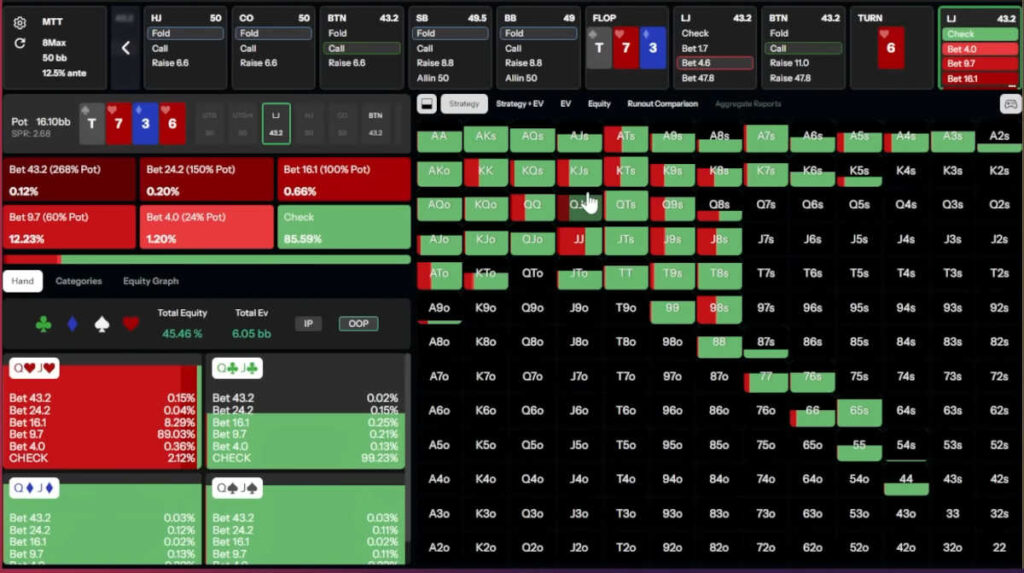
Many players will proceed to triple-barrel bluff off their stacks here, thinking they only have a queen-high, which is one of the worst hands they’ll have. However, being out of position, we want to bluff with hands that have decent equity.
In this instance, the best course of action is to just check, with a plan to give up.
We check, and the opponent checks back, getting us to the 5♦ river. This runout may seem tempting to bluff on, but we simply don’t have many fours in our range. While this is also true for the opponent, they do have quite a few top pair combos that they can look us up with.
Comparing GTO Ranges
Let’s now look at GTO ranges for both players. We notice that the opponent doesn’t have that many Tx combos, as they are not supposed to call with hands like KTo, QTo, and JTo.
This means that we do get to bet this particular flop quite frequently with hands like top pairs, overpairs, and hands we could call “draws,” i.e., KQ, KJ, QJ, K9, Q9, etc.
Another category of hands that we are betting fairly often are backdoor flush draws. You’ll notice, for example, that we are betting all of our A4 combos except A♣4♣.
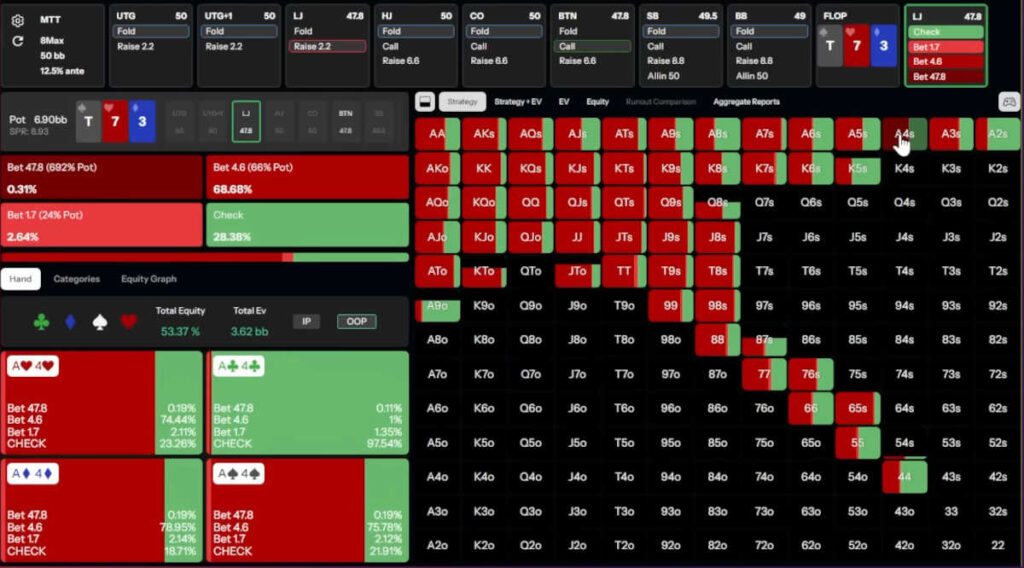
With the hands that have very little or no potential, we are checking with the intention to give up.
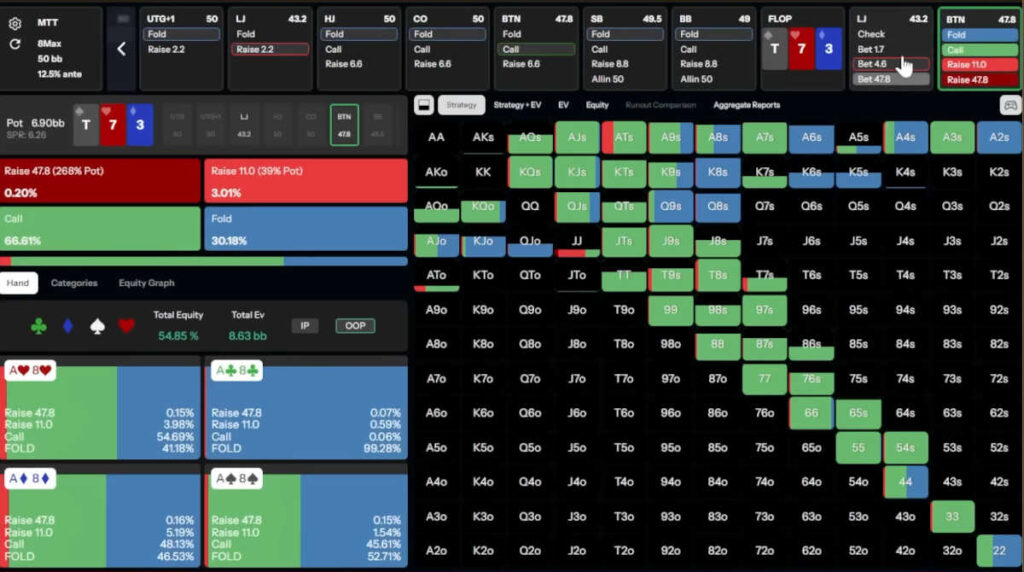
When we bet and get called, the opponent’s range tightens substantially. Facing a bet, they are folding around 30%, so the range they are continuing with is fairly strong. As a side note, you’ll also notice that the in-position player is not doing a lot of raising.
When the 6♥ comes on the turn, we have to check a lot. The only bluffs that we are continuing with are high-equity ones, like KQh, QJh, as well as K9, K8, J9, J8 (straight draws). With hands like KsJs, we are checking to give up.
When it checks through on the turn, which will happen about 50% of the time, and the river comes a 3 that doesn’t complete a flush draw, we are still supposed to give up with almost all of our QJ combos.
Interestingly enough, we do sometimes bet with Q♣J♣ specifically. If we are holding clubs, the opponent is more likely to have draws that missed and that they’ll fold on the river. The opposite is true if we are holding spades, hearts, or diamonds.
Comparing Different Boards
Even though boards can look similar, a small change to the texture can influence our strategy quite significantly.
For example, if the flop came 9♥7♦3♣, we are doing a lot more checking compared to the previous situation. On the flop of 7♥5♦3♣, we are checking even more frequently.
This goes down to the flop of 5-4-3, where we are checking pretty much every single time. Many players will bet on these textures, figuring they still have all the overpairs, but this is simply incorrect.
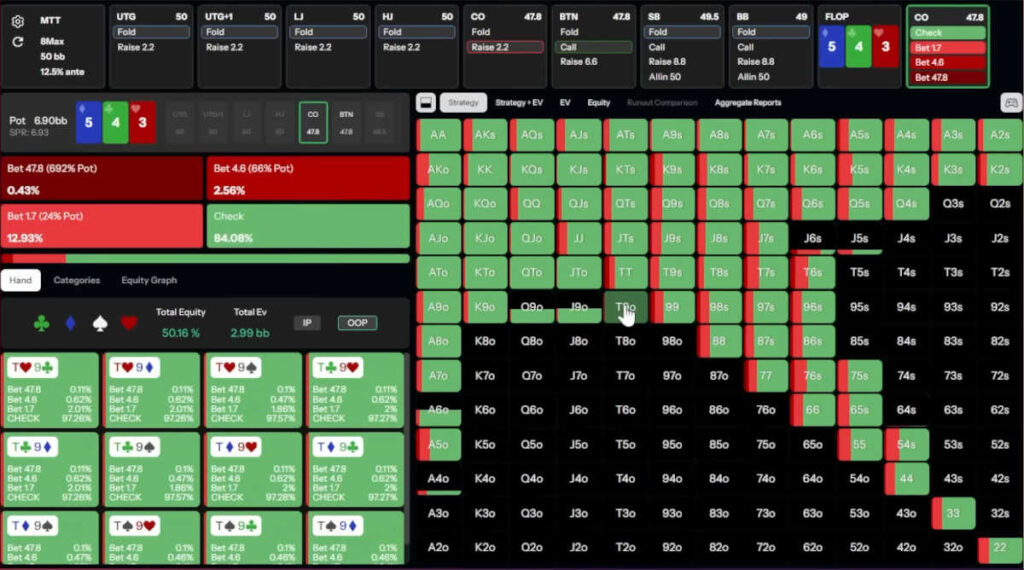
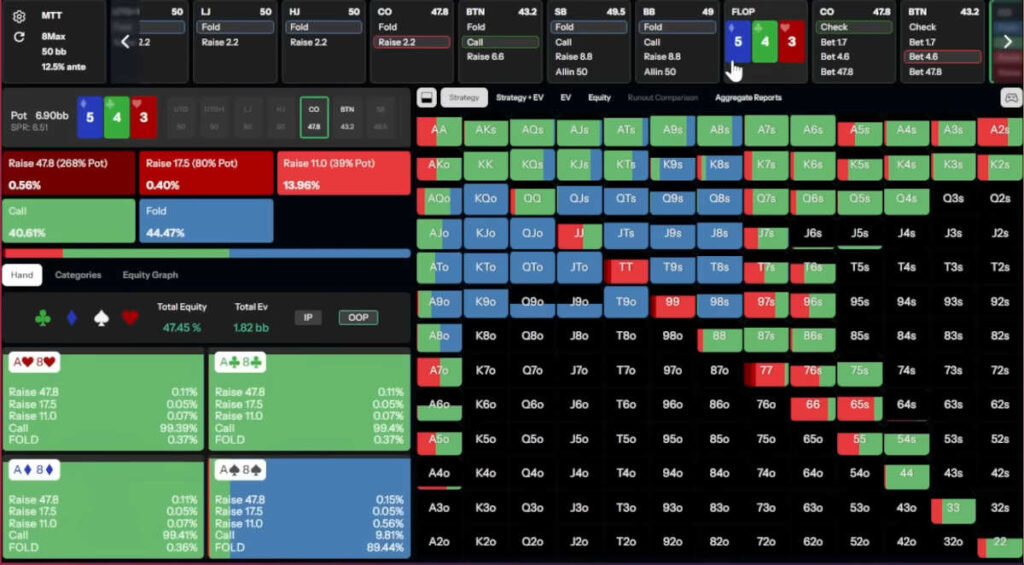
Finally, when we do check on these boards, we are doing so with a plan to check-raise some of the time. While this may feel a bit uncomfortable, we are supposed to check-raise with hands like our best top pairs (that are vulnerable), and high-equity draws, such as straight draws that have no showdown value.
The decision whether and how often to check-raise depends on the opponent’s sizing. Facing a smaller bet, we are raising more frequently, and we are going for a big raise. For example, if they bet 1.7 big blinds, we should be making it 9.9 big blinds. This puts a ton of pressure on their marginal hands.
If you want to learn more about these spots, make sure to check out the embedded video, especially the final section, where we go through some PeakGTO drills covering a variety of these spots.