Video poker has been a casino favorite since it first appeared in the late 1970s. The game feels like a mix between a slot machine and a poker table – you get the solo, quick-play experience of slots plus the decision-making and skill element of poker.
For players who appreciate a low house edge and the possibility of large wins, video poker can be an ideal choice. It’s easy enough to learn in minutes, yet mastering it can significantly improve your odds of winning, which is a big reason for its enduring popularity.
Not only how you play matters, but also where you choose to play. Video poker results depend on the fairness of the software and the accuracy of payouts, which is why licensed and regulated platforms should always be the baseline option.
Reputable casinos use certified random number generators, publish clear paytables, and offer multiple video poker variants rather than a single simplified version. A wider selection makes it possible to compare payout structures, understand differences between games, and avoid poorly balanced tables.
It is also helpful when a platform provides demo versions, allowing you to test the game before playing for real. If demo play is not available, promotions can be used instead.
For example, on some casino bonus websites you can find latest Dudespin bonuses for free play and read professional reviews, which can be important when making a decision. Choosing a secure platform with a strong video poker catalog is one of the most important steps. Now, let’s move on to learning how video poker works.
Video Poker Gameplay: How the Game Works
Once you’ve set up and are ready to play, the actual gameplay of video poker follows a simple, standardized sequence. At its heart, video poker is based on five-card draw poker but is automated and streamlined for solo play.
You’ll be using a virtual deck of 52 cards (in most variants) and aiming to make the best poker hand. Here’s how a typical round of video poker works from start to finish:
- Place Your Bet: Insert your credits and choose a bet size. You can usually wager between 1 and 5 coins per hand. (Tip: betting the max 5 coins is ideal if you’re comfortable, because it yields the highest payoff for a royal flush jackpot.)
- Deal the Cards: Click the “Deal” button. The machine (or software) will deal you five cards face-up on the screen. This is your initial hand.
- Hold or Discard: Evaluate your hand and decide which cards to keep (“hold”) and which to throw away. You do this by clicking on the cards you want to hold, the others will be discarded. For instance, if you have a pair of Queens, you’ll likely hold them and discard the other three cards in hopes of improving to three of a kind or better. If you have four cards to a flush, you might hold those four and discard the one odd card, aiming to draw that fifth suited card. This decision-making step is the strategic core of video poker – your choices here directly influence your odds of winning.
- Draw New Cards: Once you’ve selected your holds, hit the “Draw” button. The machine replaces any cards you discarded with new cards from the virtual deck. Now you have your final five-card hand for that round.
- Payout (if you win): The game evaluates your final hand against the paytable. If you’ve made a qualifying hand (such as a pair of Jacks or better, three of a kind, a flush, etc.), the machine will automatically credit your winnings according to the payout for that hand. If your final hand doesn’t meet the minimum winning hand (e.g., you ended up with just a low pair or nothing at all in a Jacks or Better game), you lose your bet for that round. You can then bet again and repeat the process for the next hand.
The beauty of video poker is that aside from pressing Deal and Draw, everything hinges on your hold/discard choices. The rules themselves are easy to grasp, and you don’t have to beat any dealer or worry about other players’ cards.
Your entire focus should be on making the best five-card hand you can out of the cards you’re dealt. This straightforward one-decision format each round is what makes the game so approachable. Even though the mechanics are simple, results depend on which cards you choose to keep and which you replace. Mastering those choices is key to improving your success.

Hand Rankings and Payouts in Video Poker
Video poker uses standard poker hand rankings, from high card up to the coveted royal flush. However, unlike in live poker, not every hand will pay out – typically you need at least a certain combination (depending on the game variant) to get a return.
In the classic Jacks or Better game, the lowest paying hand is a pair of Jacks or better (hence the name). That means if you finish a hand with, say, a pair of Queens, you’ll win a small payout (usually 1-to-1, doubling your bet). A pair of 10s, on the other hand, wins nothing in that game.
Some other variants have different minimum winning hands (for example, in Deuces Wild Poker, you usually need at least three of a kind to win because the wild cards make it easier to form hands).
Each video poker machine or online game will have a paytable displayed, which lists all the winning hands and their payouts for each coin bet.
It’s crucial to read this paytable, as it tells you the game’s rules for winning. Below is an example of a typical paytable for a 9/6 Jacks or Better video poker game (one of the most common and player-friendly versions):
| Hand | Typical Payout (1 coin bet) |
| Pair of Jacks or Better | 1 to 1 (even money) |
| Two Pair | 2 to 1 |
| Three of a Kind | 3 to 1 |
| Straight (five in sequence) | 4 to 1 |
| Flush (five of same suit) | 6 to 1 |
| Full House (three of a kind + a pair) | 9 to 1 |
| Four of a Kind | 25 to 1 |
| Straight Flush | 50 to 1 |
| Royal Flush (A, K, Q, J, 10 of same suit) | 250 to 1 (or ~800 to 1 with max coins) |
In this Jacks or Better example, if you bet one coin and get a flush, you win 6 coins (6:1 payout). A full house pays 9:1, and so on. The Royal Flush is special – it typically pays 250:1 for a single coin bet, but 800:1 if you bet the maximum of 5 coins. That’s why you see “800-to-1 with max coins.”
Noted, a royal flush is so rare and celebrated that most games give a bonus payoff when you’re betting max. In practical terms, a royal flush on a 5-coin bet in quarters (which is a $1.25 total bet) would win $1,000 (4,000 quarters), whereas the same royal on a 1-coin bet of $0.25 would only win $62.50.
The huge difference in jackpot is a big incentive for players to play max bet if their bankroll allows – it can really pay off on that one lucky hand.
Understanding payouts also means recognizing that paytables can vary. The term “9/6 Jacks or Better,” as in this example, comes from the 9-to-1 payoff for a full house and 6-to-1 for a flush. This is considered the full-pay version of the game, which yields an excellent return to the player (~99.5% with optimal play).
Some casinos might offer an “8/5 Jacks or Better” (8-to-1 full house, 5-to-1 flush), which pays less for those hands and thus has a lower overall return (around 97% RTP). As a savvy player, you should aim to play on the better paytables whenever possible, because over the long run they give you a much higher chance of coming out ahead or at least breaking even.
In fact, with perfect strategy, a full-pay Jacks or Better machine has a house edge of only about 0.5%, meaning the game returns about 99.5% of wagers on average. That’s one of the best odds you’ll find in a casino for a game that’s so accessible.
The key takeaway: always look at the paytable. Know what the winning hands are and how much they pay, and prefer games with generous payout schedules. It can make a meaningful difference to your bankroll over time.
Popular Variations of Video Poker
Jacks or Better
This classic version serves as a great starting point for beginners. As the name implies, you need at least a pair of jacks (or any higher-ranking pair, like Queens, Kings, Aces) to get a payout. It has no wild cards. Jacks or Better typically has a balanced paytable and is known for its relatively low volatility and high return when using the full-pay 9/6 paytable.
Deuces Wild
In this exciting variant, all four “2” cards (deuces) act as wild cards that can substitute for any other card to form a hand. With wild cards in play, it becomes easier to make strong hands, so the paytable is adjusted.
For example, in most Deuces Wild games the lowest paying hand is three of a kind (since a single pair with wilds would be too easy to get). Hitting five of a kind is possible thanks to wilds, and there’s even a special hand called “wild royal flush” (a royal flush that includes a deuce wild), which has its payout.
Deuces Wild tends to have a high variance (the wilds can create big wins or long dry spells), but it also offers some of the highest potential returns if played with perfect strategy.
Bonus Poker
This is a family of games based on Jacks or Better but with a bonus twist. Bonus Poker keeps the Jacks-or-better rule for minimum hand, but it offers higher payouts for certain four-of-a-kind hands.
For instance, four Aces might pay a bigger bonus than a four of a kind of lower-ranked cards. This means if you’re lucky enough to hit quads, you get rewarded extra. The trade-off is that some other payouts (like for a full house or flush) might be slightly reduced to balance the overall payback.
Double Bonus & Double Double Bonus
These are popular extensions of Bonus Poker. Double Bonus Poker further increases the payouts for four-of-a-kind (especially Aces, 2s, 3s, and 4s), making those hands extremely lucrative. It usually pays 10/7 (full house 10:1, flush 7:1) on the paytable, which compensates for the bigger four-of-a-kind prizes.
Double Double Bonus Poker adds even more excitement by introducing “kicker” cards – certain four-of-a-kind hands pay extra if they are accompanied by a specific fifth card (for example, four Aces + a 5 as a kicker could pay a premium jackpot).
These games have higher volatility because they funnel more of the payout into the rare four-of-a-kind hands, but they’re very popular among players chasing those big hits.
Joker’s Wild (Joker Poker)
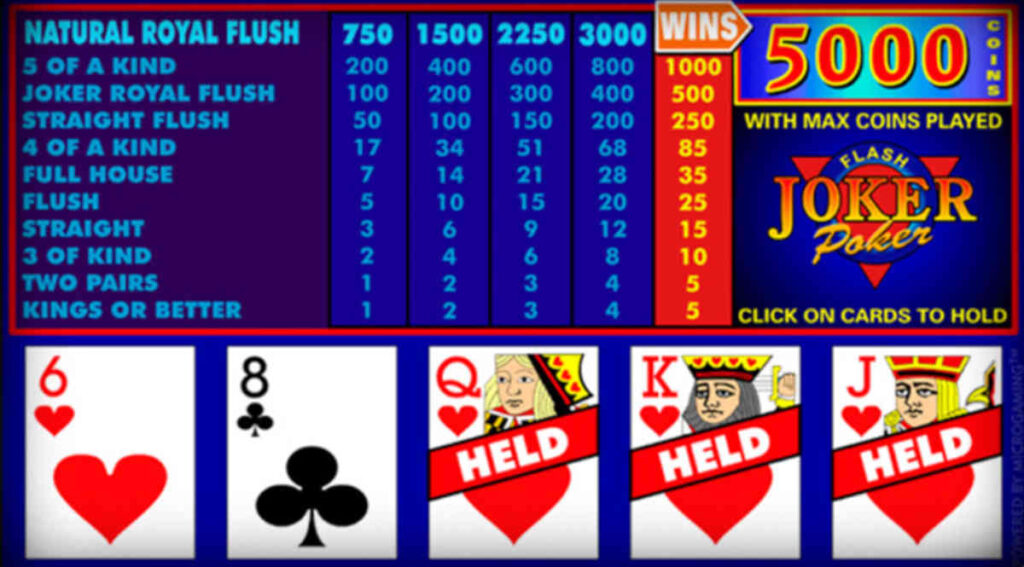
In this variant, a joker card is added to the deck as a wild (making it a 53-card deck). The joker can stand in for any card, similar to deuces in Deuces Wild. Because of the added wild, the game typically requires a higher minimum hand to win, often two pairs or a pair of Kings/Aces or better, depending on the specific rules. Joker Poker is another fun twist that gives you more chances to make big hands like five of a kind.
Tips and Strategies for New Video Poker Players
While luck plays a role in which cards you’re dealt, video poker is not purely a game of chance. Every hand presents a decision, and making the right calls will significantly improve your results over time.
- Learn Basic Strategy for Your Game: Each video poker variant has an optimal strategy, a set of guidelines for which cards to hold in every possible situation to maximize your expected payout. It’s highly recommended to at least study a basic strategy chart for the game you’re playing. For example, in Jacks or Better, a simple rule is to always hold any winning hand (don’t break a pat hand that’s paying, except in one special case we’ll mention shortly). If you have a high pair, keep it. If you have two pairs, keep both (that guarantees at least a Full House if one more matching card hits). If you have four cards to a flush or straight, it’s usually wise to draw one card to try to complete it, rather than keeping a single high card. Over time, you’ll memorize the best plays. Remember that for every unique deal of five cards, there is generally a mathematically best choice of what to hold. Many online video poker games even offer “hint” features or will automatically highlight recommended cards to hold for beginners. Use these tools to learn, but also understand why those holds are suggested.
- Know When to Go for the Big Win: One hallmark of video poker strategy is recognizing those rare opportunities to chase a huge payout. The classic example is holding four cards to a Royal Flush. A royal flush is the highest hand (e.g., 10-J-Q-K-A of the same suit) and has a jackpot-level payout. If you ever find yourself one card away from a royal, you should discard your fifth card (even if that fifth card made, for example, a small winning hand like a flush or a straight) and try for the royal. It’s a calculated risk worth taking because the royal flush payout is extremely high, especially with a max bet. Even if you sacrifice a sure smaller win in doing so (like breaking a made flush), the mathematics and the potential reward favor chasing the royal in that scenario. This specific tip highlights an important concept: sometimes you should forego a guaranteed minor payout to try for a much larger payout, but only when the odds and paytable justify it. Outside of these special cases, though, hang on to any guaranteed wins you have. Never throw away a paying hand in hopes of something better, except when it’s the correct strategic move (like the four-to-royal situation). By learning the nuances, like which hands to hold at all costs and when it’s okay to gamble a bit, you’ll greatly improve your video poker performance.
- Stay Disciplined: Finally, remember that video poker is meant to be fun. Its mix of strategy and luck can be very engaging, almost like a puzzle with each hand. Avoid the temptation to deviate from a solid strategy due to hunches or frustration. Trust the math in the long run, even if you encounter a period of no wins. Utilize resources, such as strategy charts, online calculators, or even the game’s built-in suggestions, to reinforce good decision-making habits. Keep your sessions within your financial comfort zone so that a bad streak won’t sour the experience.