Image courtesy of World Poker Tour
Pocket aces is my absolutely favorite poker hand, and for a very simple reason. It is the most profitable hand of them all, and it’s not even close.
However, I still often get questions from players, complaining about their aces often getting cracked. If this is the case, you may find that you play in a manner where you let your hand get outdrawn.
Another complaint I hear often is that they never really win big pots with aces.
In both of these scenarios, you’re probably making certain errors along the way, and whenever there are mistakes in your game, you won’t be able to make as much money as it is possible in certain spots.
If you can correctly identify and fix these leaks, you’ll get in a spot where you lose less when you do happen to get outdrawn (which will happen sometimes), and you’ll be able to win more money when you do have the winner.
Mistake #1: Trying to Play Tricky Before the Flop
To make money in poker, you should primarily play good, strong, and fundamentally strong strategies, which means putting in a lot of money with hands that are almost always good but susceptible to being outdrawn.
In other words, stop trying to be coy and trick people.
In most cases, when you have pocket aces, you’ll want to raise and re-raise with them. If you’re first in, start with a raise. Don’t limp in, hoping someone else will raise behind.
First of all, you’re putting yourself in a spot where, if nobody raises, you’ll be up against several opponents with wide ranges, trying to navigate the hand. And when someone does raise, and you limp 3-bet, most people will know exactly what’s up.
Some opponents may still go for it, but, unless you do this with some weaker hands as well, which is really hard to balance, any observant opponent will be able to put you on an extremely narrow range and play perfectly against you.
If there is a raise in front of you, you’ll want to 3-bet, making it 2.5x-3.5x the raise in position and 3-4x out of position.
When dealing with a raise and a call in front of you, a nice formula to use is three times the initial raise, plus any additional money in the pot. If somebody raises to $7 and two players call, you should make it $21(3x$7) + $14 ($7+$7) plus maybe a little extra for blinds and antes – so in this case around $35 – $36.
This ensures you’re not giving your opponents good pot odds to call, and, when they do call, you’re building a nice pot.
When to Slow-Play Your Aces?
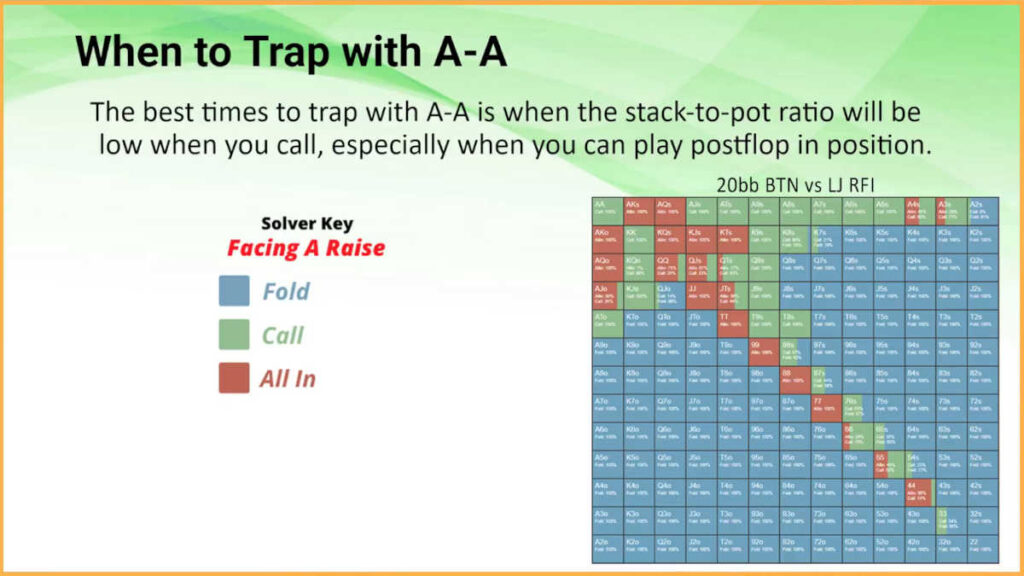
You should stick to these general principles for the most part, but there are some scenarios where playing your pocket aces tricky makes sense. This is almost always in spots where the stack-to-pot ratio will be low after the flop.
As you have less money in your stack compared to what’s in the pot, you start not to mind slow-playing, as your opponent will be drawing relatively thin, and when they do happen to outdraw you, they won’t be able to win much.
For example, you have 20 big blinds on the button and a lojack player opens. In the GTO strategy, we are always just calling here. The SPR will be low on the flop, so we don’t mind flat calling, and by keeping aces and kings in our range, we can call a bit wider.
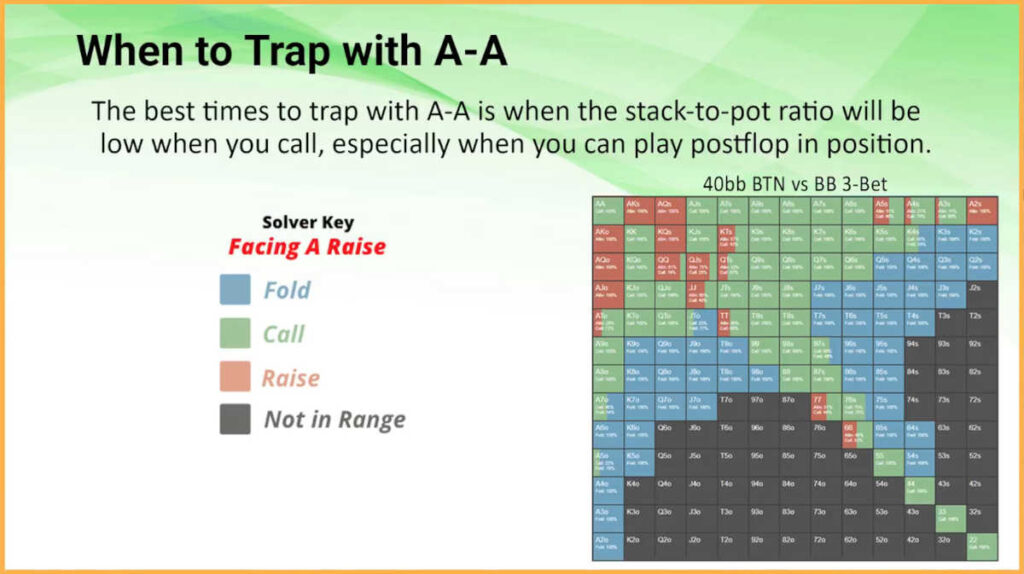
Another scenario is where we are 40 big blinds deep, open with our pocket rockets (as they are often nicknamed) from the button, and the big blind 3-bets. When we just call, our stack-to-pot ratio on the flop will be about two-to-one, which is quite shallow.
Mistake #2: Overplaying Marginal Made Hands
Overplaying marginal made hands is one of the most common mistakes I see players make across the board.
When it comes to pocket aces, common scenarios are when you are playing deep stacked on a very connected board, when you are up against multiple opponents, or when a lot of money goes into the pot and you only have one pair.
Let’s look at an example.
Playing $1/$2, we make it $8 from the LJ position and the big blind calls. The flop comes 6♠5♣4♥ and the opponent checks.
This is a common spot that you need to master. The default play here is to check back because, when you raise from LJ, you don’t have that many great hands on this flop. Your range consists mostly of over-pairs and high cards that missed the board.
If you bet and your opponent raises, they’ll effectively turn all your over-pairs into bluff-catchers.
These days, the level of play has become higher, so you have to adjust accordingly. Opponents will put you in tricky spots, so you need to tailor your strategy accordingly.
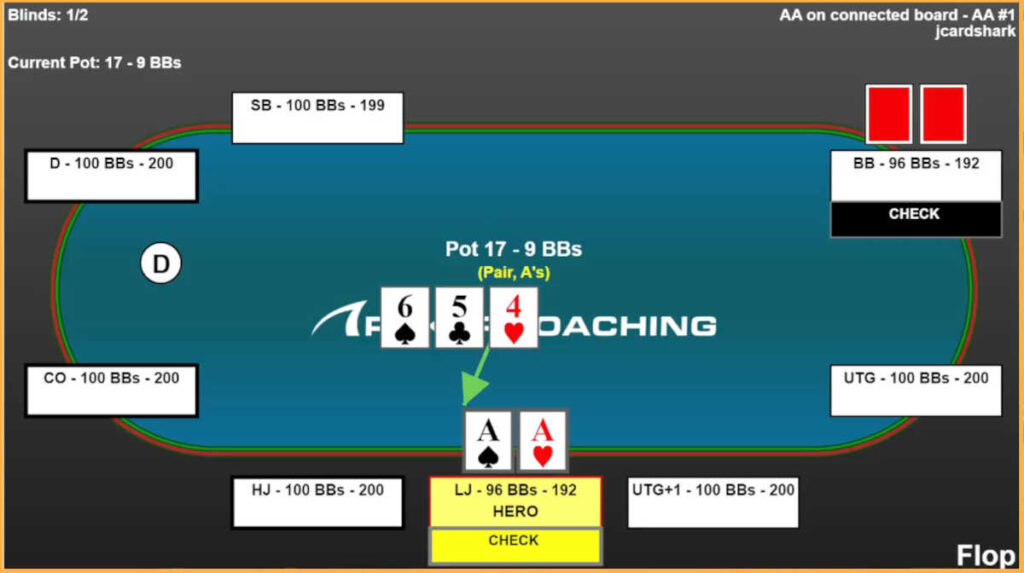
After it checks through on the flop, the turn comes K♥ and the opponent leads out for $15. We should just call here, as raising doesn’t make much sense. We could be crushed here, and, if not, we allow the opponent to bluff or bet for value with weaker hands, like KQ, KJ, and KT.
The river is the Q♠, and the opponent once again bets for $30. This is again an easy call. You may be thinking, why not raise against the smaller river sizing, as they probably don’t have the nuts?
However, I think this is a big enough bet where we just call, and I wouldn’t be shocked to see a random two pair here.
In this particular scenario, we call, and the opponent shows 6♦5♦, so we lose the pot. However, it could have been much worse if we bet on the flop and faced a re-raise, because we can’t really fold on an effectively blank king on the turn and queen on the river.
In poker, penny saved is penny earned.
Mistake #3: Missing Thin Value
Most players at small stakes are too worried about being bluffed. They are concerned that, if they bet thin for value on the river, they’ll get raised and have to fold.
The reality is that this doesn’t happen all that often, and you need to go for value in spots where you are likely to have the best hand. And in those rare spots where you do get raised, you should definitely fold against most players.
Let’s say the LJ open to $15 playing $2/$5, and we are on the button with A♠A♣. We are playing 100 big blinds deep, so we definitely want to re-raise and make it $50.
The opponent calls, and the flop comes K♠J♠10♣. After they check, we bet small, as we have a lot of very strong hands here. So, we make it $25, and they call.
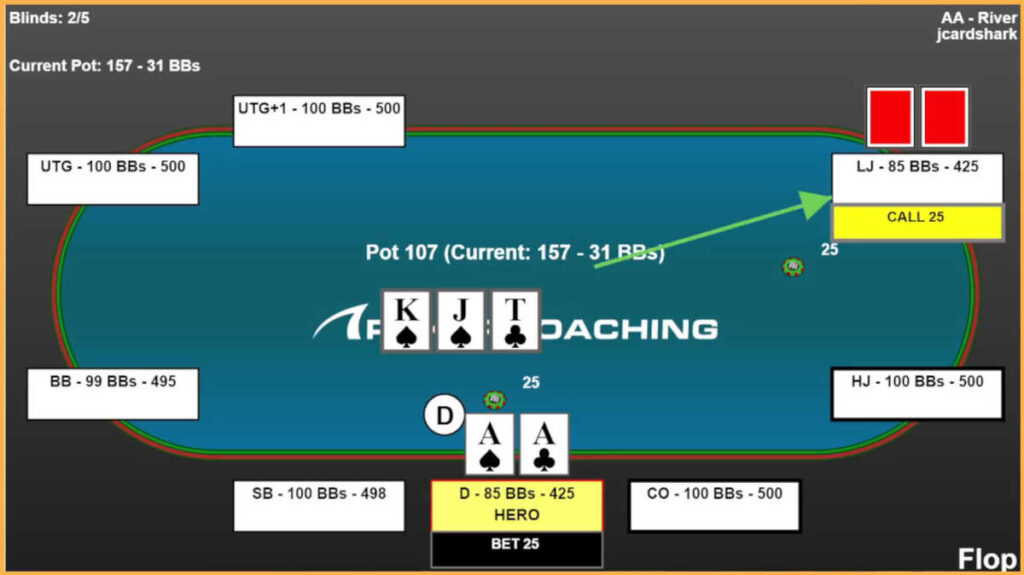
The turn is the 6♦, and when they check, we can check back or continue betting. Checking is more of a GTO play, while betting is an exploitative approach, where you can do it if you know that the opponent will always check-raise the flop with better hands.
Here, we check back and proceed to the 2♠ river. Once the opponent checks, most small stakes players check back. However, you need to realize that your opponent has a lot of hands that are strong enough to call a reasonably sized bet. And if they raise you, you can fold.
In this particular hand, we bet $80, and the opponent calls with A♦K♦ that they decided not to 3-bet before the flop.
The most important takeaway is that you need to be able to recognize these spots and go for thin value when the opportunity presents itself. Your opponents will have strong enough hands to look you up quite often, which will bring a lot of value over time.
And when you do run into a very infrequent river check-raise, you can just fold and move on. This fear is not something that should ever stop you from going after value in good spots.