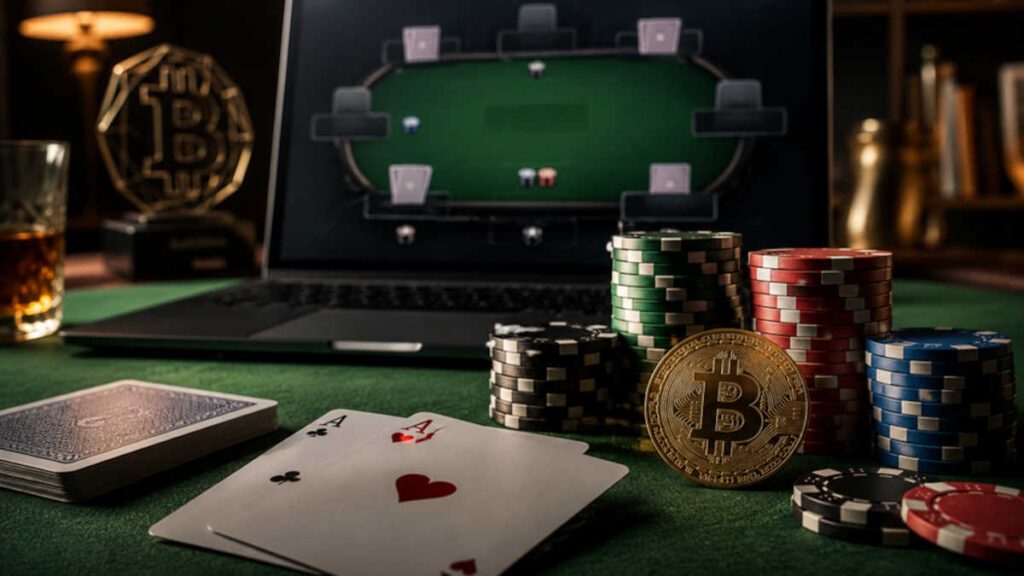
Online poker has always followed the money, and in 2026, the money is moving on-chain.
A format that once depended on bank wires, e-wallets, and the occasional paper check mailed from an offshore room is being rebuilt on blockchain rails.
The players driving that shift are younger, more mobile, and far less patient than the cohort that fuelled the original poker boom.
Why the Players Went Crypto
The shift runs deeper than a new payment button, and the numbers around poker show how far it has traveled. The online poker market sits at roughly $6.2 billion in 2025 and is climbing steadily, but the more telling figure comes from the wider category around it: crypto casinos now account for nearly 17% of all iGaming bets globally, up from almost nothing five years ago.
Much of that growth runs through the same platforms poker players already use. A modern bitcoin casino typically bundles cash games and tournaments alongside slots and table games, which means the liquidity, the bonuses and the player pool increasingly live inside one crypto-native ecosystem rather than in the siloed fiat rooms of the previous era.
Faster Payouts, Lower Fees
To understand why, it helps to see where online poker has been. The game passed through three broad eras:
- “The fiat-only” boom of the 2000s
- The regulatory tightening of the 2010s
- The crypto-native phase unfolding now
Traditional operators leaned on card processors and bank transfers that limited cross-border access and slowed cashouts. Crypto rails stripped much of that friction out. Bitcoin enabled payments without intermediaries, stablecoins added price stability, and Layer 2 networks cut transaction fees to fractions of a cent.
For players, the most immediate change is speed. There was a time when a withdrawal meant waiting weeks for a check to clear in the post. In 2026, the standard has inverted so completely that any room failing to settle a balance in under 15 minutes is considered behind the curve.
Deposits and withdrawals clear on-chain in minutes rather than days, fees shrink because banking intermediaries are cut out, and privacy improves because the player shares a wallet address instead of sensitive banking details.
How Stablecoins Handle Volatility
Cryptocurrency introduces its own risk at the felt, and experienced players have learned to manage it. Winning a large pot in Bitcoin is only half the job: if the asset slips 10% before the withdrawal processes, the night’s profit can evaporate.
This is the volatility trap, and the common fix is the stablecoin. Many rooms now convert deposits into USDT or USDC the moment a player sits down, so chip values track the dollar rather than the wider crypto market.
Stablecoins have quietly become the default settlement layer for everyday play, with Bitcoin reserved for high-stakes liquidity and larger transfers.
What Provably Fair Gaming Means
Blockchain has also changed how players verify that a game is honest. Instead of trusting an operator’s word about its random number generator, modern rooms publish provably fair proofs.
Parts of the game, such as hand histories or shuffle data, can be recorded or referenced on-chain so a player can independently confirm the deck was not altered after the shuffle. For a game where users compete directly against one another for real money, that level of transparency is becoming a baseline expectation rather than a selling point.
Game Variety and Rakeback
None of this would matter if the games themselves were thin, but the crypto-native rooms have closed that gap. Players will find the full spread of formats, from Texas Hold’em and Omaha to Seven Card Stud, Six Plus Hold’em, and fast Sit and Go events built for mobile sessions.
The ongoing value has shifted alongside the formats, moving away from one-off promotions and toward recurring rewards. Rather than competing on a flashy welcome banner, serious rooms now compete on rakeback, with crypto-first platforms advertising rakeback up to 33% and offshore operators like ACR structuring loyalty programs that reach as high as 65%.
What Comes Next for Crypto Poker
What makes 2026 different is that crypto poker has stopped reading as a niche experiment and started reading as the default. The audience entering the game expects mobile-first interfaces, near-instant payouts, and minimal verification friction, and it is largely indifferent to whether the rails underneath are fiat or blockchain.
The operators winning that audience are the ones treating crypto as core infrastructure rather than a checkout add-on, and the line between a regular poker room and a crypto poker room fades a little more each quarter.
For a generation that already holds its money in a wallet, sitting down at an on-chain table is less a leap than a continuation of how it lives the rest of its financial life.