Images courtesy of WPT.com
In poker, success isn’t just about how you play your cards—it’s also about how you conduct yourself in the room and on the table.
While players spend countless hours studying strategy and game theory, far too many overlook the basics of live poker etiquette. These aren’t just “nice to have” rules—they’re essential for maintaining a respectful, professional, and safe environment for everyone involved.
From respecting dealers’ personal boundaries to following simple courtesies like not rabbit hunting without tipping extra, managing chip racks, and staying home when sick, good behavior at the table matters.
In this article, we’re diving into poker faux pas players should never make.
Don’t Touch Dealers
One of the biggest no-no’s in a poker room is also one of the simplest: keep your hands to yourself.
Touching a dealer during live play is not just bad etiquette—it can be deeply uncomfortable, distracting, and even frightening for the person working hard to keep the game running smoothly.
As dealer Miki Penza, who has worked in multiple roles in the casino industry over three years, explained,
I found that it is insulting for players to assume that they can just touch the dealer.
Penza described a $1-$2 game where a player, upset after losing a hand, “grabbed my arm and yelled at me, ‘Why would you do that to me?’” – an action that left them “highly uncomfortable.”
Michael David, a dealer with seven years of experience, put it even more bluntly:
It is ok to touch a dealer when another dealer taps them on the shoulder at push time. That’s the end of the list. No one sitting in the game should ever touch the dealer.
Even friendly or seemingly harmless contact isn’t appropriate during live action. As Lauren Morton, a dealer with three years of experience, shared,
If it’s strictly a player/dealer relationship and I am dealing, I do not want to be touched.
She recalled players slapping her hand away or even backhanding her shoulder after an unfavorable river card—a behavior she described as “extra” and uncalled for, even if she typically responded with just a cutting glare.
Touching dealers doesn’t just violate personal boundaries—it actively disrupts the delicate balance they maintain at the table.
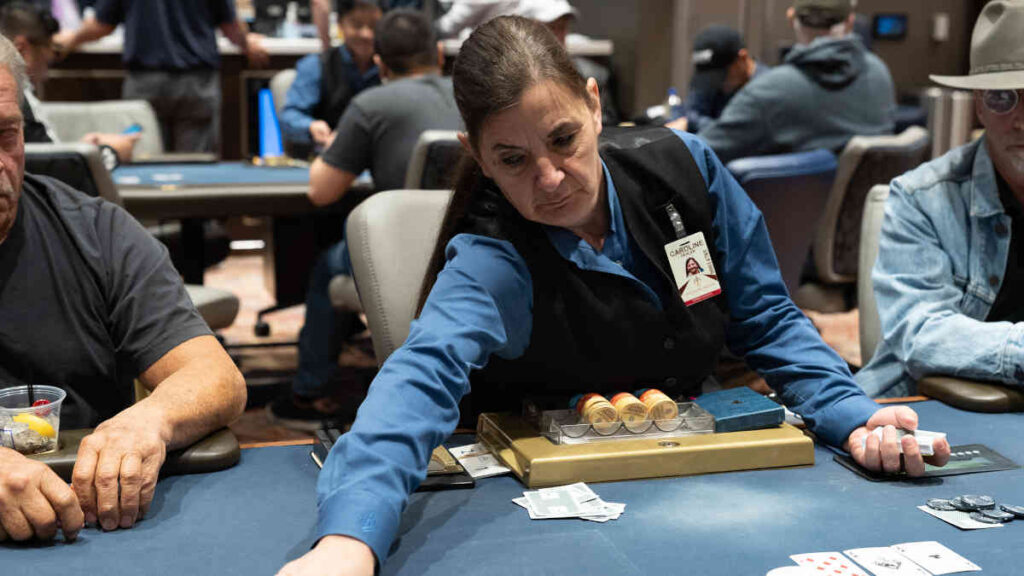
“A good dealer is focused on dozens of things all at the same time,” said Gary Turner, a veteran with over 30 years in the business. “A player reaching out and making physical contact is highly disturbing, not to mention extremely unhygienic and just rude.”
Turner emphasized that unwanted touching is a serious matter: “Unwanted touching is assault or harassment; take your pick.”
Some players argue there are rare cases where a quick tap or block is needed to prevent a major mistake, such as stopping a dealer from mucking a winning poker hand.
One anonymous dealer with 13 years of experience allowed that a “touch or block on the hand”—never grabbing—may be acceptable in those specific moments. Still, even then, players should be cautious and defer to casino staff whenever possible.
Jennifer Cullen summed it up clearly:
The only time it’s OK to touch a dealer is when a dealer invites it. Touching me while I’m in the box doing my job is never appropriate.
She expanded her list of “firmly off-limits” examples by adding poking, shaking, or massaging a dealer during play.
For some, unwanted contact has escalated into truly frightening situations. Heather Bailey shared that she once had to have a player banned after he became physically aggressive towards her; she needed players and security to intervene.
Another dealer recalled experiences of being sexually harassed and touched inappropriately during greetings – an all-too-common violation that leaves a lasting impact.
The stories don’t stop there. One dealer shared a disturbing experience where a player, who also happened to be a dealer at another casino, attempted to pull a disgusting stunt:
Before I sat down at a table, a player in seat nine put his hand on my seat so I would sit on his hand, and I did. I got very upset, called the floor, and he got kicked out.
She added that because she was assertive, the offender didn’t attempt it again with her—but it raised concerns about how often such behavior might go unchecked with others.
Another dealer with two years of experience, who wished to remain anonymous, described two particularly upsetting incidents.
In one case, a player who had just won a huge pot tried to kiss her on the lips as she continued dealing the next hand.
“I immediately denied the action and told him you are not allowed to cross my boundaries,” she recalled.
Although he apologized repeatedly, the damage was already done.
The second incident was even more egregious. After declining a player’s earlier sexual proposition, she later found him pretending to retrieve a fallen chip near her feet.
He took his chance to touch me beginning at the back of my right ankle, gliding up the back of my leg.
She immediately screamed, “Oh no! We are NOT doing that! Do NOT touch me!” and stopped the action at the table, spreading the cards and making a loud announcement to make it clear such behavior would not be tolerated.
Although the player again apologized and threw her a green chip—an act that trivialized the violation—the situation highlighted the hostile environment many female dealers endure.
“It’s crazy how men in poker treat female dealers,” she reflected. “It’s either verbal belittlement because they do not care for us as dealers, or they simply objectify females as their sexual targets.”
A dealer who wished to remain anonymous and had extremely negative experiences having been touched inappropriately also shared that women aren’t alone in being physically assaulted; this happens to men also:
I have male friends that have to deal with it [too]. They tend to laugh it off a little more than we did. Women sitting in the one or nine seat [will reach] over and grab their junk or play footsies under the table.
The bottom line is simple: keep your hands to yourself. Touching a dealer—whether out of anger, excitement, or misguided friendliness—is never acceptable unless explicitly invited.
Dealers work hard to maintain a professional, safe, and respectful environment, and physical contact only undermines that effort. What may seem like a harmless gesture to you can feel invasive, threatening, or humiliating to someone else.
Respect the dealers, respect the game, and respect the boundaries. It’s not just about good etiquette—it’s about basic human decency.
Don’t Rabbit Hunt (But Tip If You Insist)
Rabbit hunting – asking a dealer to reveal what the next cards would have been after folding – is one of the most common bad habits poker players try to sneak into live games.
Whether it’s asking for the turn and river after folding on the flop, or even wanting a glimpse of the flop after an early fold, rabbit hunting only serves one purpose: satisfying curiosity about a hand you didn’t finish.
Generally speaking, unless you’re in a private home game, rabbit hunting is against the rules. And for good reason. It slows down the game, can create unnecessary emotional swings (for both the player asking and others at the table), and ultimately doesn’t matter – because you folded.
As dealer Neil Jones, a poker industry veteran since 1988, puts it,
If the house rule is no rabbit hunting, then there’s no rabbit hunting. I don’t have to agree with the house rules … my job is to hopefully add to the consistency of the games.
Rabbit hunting can tilt players unnecessarily, especially if the “would-be” board would have made them a big hand.
As one experienced dealer noted, “It can really end up tilting a player with what could have been.” It’s a dangerous trap of “what-ifs” that can easily unravel a player’s focus.
Dealers are usually firm about it—especially in tournaments. Nāte JØhn, a dealer with over eleven years of experience, says, “Absolutely never in tournament settings. I’ll just laugh and say, ‘Sorry, I can’t.’”
Even in cash games, most dealers are bound to house rules, but if they do allow it, a tip is expected. As Nāte points out,
If I’m doing an extra service for you like rabbit hunting, then yes, I’d expect a tip.
Lane Medina, dealing since 2016, agrees. He’ll generally tell players, “We don’t do that here,” but if someone’s polite and persistent, he’ll sometimes “drop the deck in front of them to grab if they want.”
Still, he stresses that tipping is important when asking for something outside the poker rules.
Sandra Q, a dealer since 2005 who has in recent years moved into a floor position, shared that she takes a player-friendly approach.
She will tell players “No” to rabbit hunting, but “if they’ve been tipping me well, I will look at the card myself and tell them ‘yes’ or ‘no’. I’ll try to do it discreetly so nobody can tell. [This occurs] usually while I’m washing or shuffling or putting the cards together after a hand.”
Home games are often more flexible. An anonymous dealer shared that while rabbit hunting is typically allowed in those settings, it’s still frustrating when players who never tip make constant special requests.
In some casinos, even when rabbit hunting was allowed, players were required to pay a set fee to the house.
As Mikey “Bordeaux” Piepho, a poker lifer with more than 30 years around the game, summed up:
If you go above and beyond, you should get chipped up.
At the end of the day, rabbit hunting is an unnecessary risk. You won’t change the game’s outcome, you might tilt yourself, and you slow down the game for others, but if you’re doing it in a place where it’s even slightly tolerated—be sure to tip.
Don’t Come To Play When You’re Sick
Poker is a game of skill, stamina, and – whether we like to admit it or not – close quarters. Players share cards, chips, and sometimes, unfortunately, germs.
I’ll be the first to admit that I once made this mistake: I came to play at the tail end of a cold. When I coughed at the table, another player called me out.
I was so ashamed. Looking back, I realize I absolutely should have stayed home rather than risking the health of the staff and fellow players.
Suzanne Clemente, a dealer with two years of experience, echoes this plea:
I would love to tell poker players—if you are sick…stay home! We, as travel dealers, front quite a bit of money and time to make it to your casino to provide players with the ability to play and win money. I can’t tell you how many times I have ended up sick at a stop! Therefore, I cannot work and earn the money I need to, at the very least, cover my expenses! Between the players sitting right next to you and the ones who sneeze and cough in their hands and then touch the cards and chips, it makes it very hard for us to stay healthy!
Now, if you’re in a multi-day tournament, which means you must play when sick, then wear a mask and please make sure to wash your hands often. Be fair to the casino staff, your dealers, and your competitors.
Every time you bring a virus to the table, you’re not just risking your opponents—you’re jeopardizing the dealers’ livelihood too.
In a profession that often lacks paid sick leave and relies on day-to-day earnings, spreading illness can have real consequences beyond a few missed hands.
If you’re feeling under the weather, do everyone a favor: stay home, get some rest, and come back strong. The cards will still be there when you’re healthy.
Don’t Abandon Your Chip Rack
One of the often overlooked but important etiquette points in a casino poker room is properly handling chip racks. Recently, veteran tournament director Matt Savage highlighted an ongoing player issue: leaving chip racks lying around. Savage posted on Twitter/X, “Put your rack in a proper place, stop being lazy[!]”
In doing so, he shared a great video showing places where not to put racks such as:
- Throwing them somewhere
- Putting them on the floor in an aisle
- Placing them under the middle of the table
- Stashing them under a player’s seat.
Places where to put racks is also presented, such as:
- Giving them to the dealer
- Giving them to the floor
- Putting them on a drink table or an empty table
- Putting them in an area with other racks.
It’s not just about neatness—it’s about safety and efficiency. Loose racks can trip players, dealers, and floor staff moving quickly across a crowded room.
It also adds unnecessary work for the casino employees who already have their hands full during busy tournaments or bumping cash games. You are a player in a casino, not a child who needs the help of an adult to clean up after you.
Poker player Todd Witteles chimed in as well, emphasizing that:
Way before [Matt Savage] talked about empty racks on Twitter, I was putting mine on empty tables nearby. Just felt like a dick thing to do, to leave it on the floor. When losing in cash, I leave it on the side table next to me, to torture myself.
In a game that thrives on mutual respect and professionalism, being careless with something as simple as a chip rack says a lot about a player’s respect – or lack thereof – for the environment and the people in it.
Robbie Williford, the tournament director at MGM National Harbor, also shared that:
I compare the rack situation to putting back your shopping cart when you’re done shopping. In my opinion, [it’s] one of the best tests of character there is. Nobody is there to force you to put it back and there are no consequences if you leave it out. However, someone else has to go further to get it or someone has to clean up after you if you don’t return it. Perfect litmus test for human decency and the majority fail the test. In short, be a better person!
I confess that I used to put the rack at my feet or in my purse (which sometimes meant bringing one home with me from time to time, whoops!), so I’m going to be better about this one myself!

Simply put, when you’re done using a chip rack, put it back where it belongs. It’s a small action that helps maintain the flow, safety, and spirit of the game.
Conclusion
Poker is a beautiful, complex game built not just on competition, but on community. Respect for the people who deal the cards, manage the room, and sit beside you matters just as much as respect for the game itself.
Whether it’s keeping your hands to yourself, following house rules without argument, protecting others’ health by staying home when you’re sick, or simply returning your chip rack, these small actions add up.
They create an environment where everyone—dealers, players, and staff alike—can focus on what they came to do: Enjoy the game. Remember—how you conduct yourself at the table is as much a part of your reputation as how you play your hands. Choose wisely. Good luck on the felt and run good!